Description
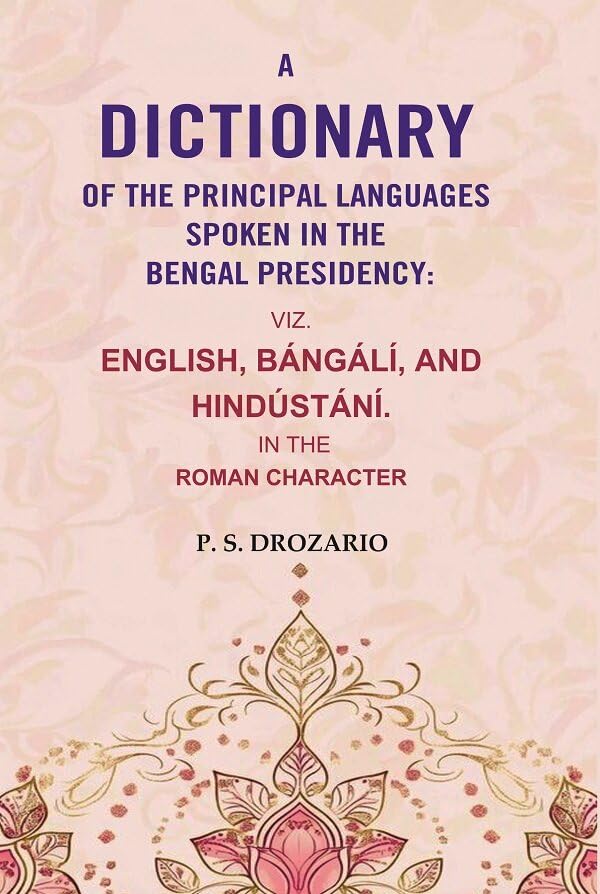
This rare historical dictionary is a scholarly treasure for anyone interested in 19th-century Indian languages and colonial-era Bengal. It brings together English, Bengali, and Hindustani in a single reference work, transliterated into Roman characters for accessibility. Whether you’re a linguistics student tracing language evolution, a historian researching Bengal’s cultural heritage, or simply curious about how these languages were documented and standardized, this 536-page volume offers authentic period insights. The Roman character transliteration makes historical texts readable to modern learners. An essential resource for language scholars, postgraduate researchers, and those passionate about India’s linguistic legacy.
- Reading age: 12 years and up
- Print length: 536 pages
- Language: English
- Dimensions: 21.59 x 13.34 x 3.75 cm
- Publisher: Gyan Publishing House
- Publication date: 1 January 2024
- ISBN-10: 9367807554
- ISBN-13: 978-9367807552
Frequently Asked Questions
Who will benefit from this Bengal Presidency dictionary?
This book is ideal for linguistics students, historians of colonial India, Bengali language researchers, and anyone studying 19th-century Indian languages. It’s particularly valuable for academics examining how Bengali and Hindustani were documented and standardized during the British Presidency period.
Is this dictionary in Roman characters or Devanagari script?
This dictionary uses Roman character transliteration, making it accessible to modern readers and language learners who may not be fluent in traditional scripts. All three languages—English, Bengali, and Hindustani—are presented in Roman script.
What makes this a historical reference?
Published in its original form during the Bengal Presidency era, this dictionary captures how English, Bengali, and Hindustani were lexically defined and used together in colonial India. It’s a primary source for understanding language evolution and cultural documentation of that period.
Can I use this for learning Bengali or Hindustani today?
While primarily a historical reference, it can supplement modern language learning by showing etymological roots and historical usage. However, contemporary language learners may prefer modern Bengali or Hindustani learning materials alongside this scholarly resource.
How many pages does this dictionary have?
This dictionary contains 536 pages of comprehensive language entries, making it a substantial reference work suitable for detailed research and academic study of 19th-century Indian languages.