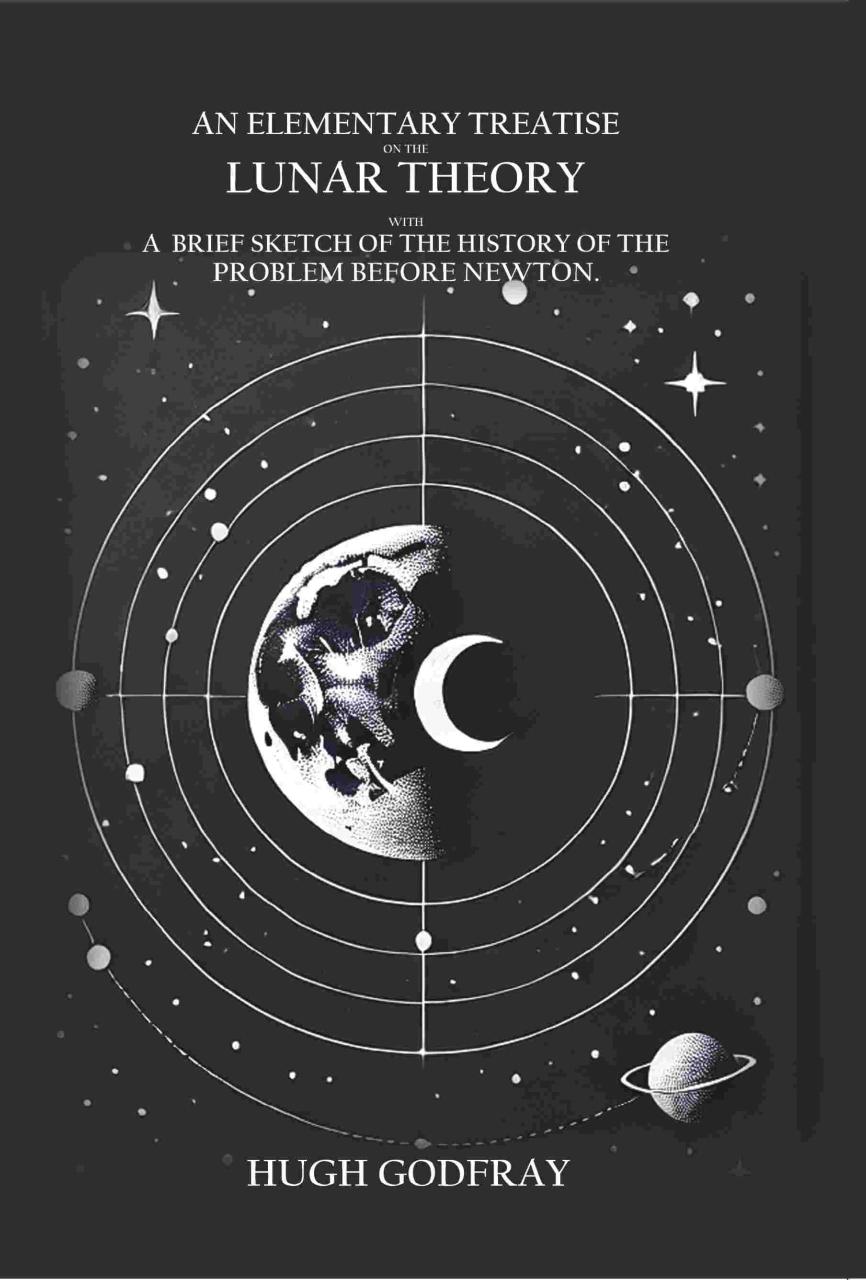
Description
This elegant mathematical work traces the fascinating story of lunar theory from ancient times through Newton’s revolutionary insights. Perfect for students and mathematics enthusiasts, the book presents complex celestial mechanics in an accessible, thoughtful way. Whether you’re studying history of science, classical mechanics, or the mathematics behind planetary motion, you’ll find clear explanations and historical context that brings 18th-century astronomy to life. At just 142 pages, it’s a concise yet comprehensive exploration of one of mathematics’ greatest puzzles—why the moon moves as it does. A rare gem for anyone curious about how Newton changed our understanding of the cosmos.
- Reading age: 12 years and up
- Print length: 142 pages
- Dimensions: 21.59 x 13.34 x 0.99 cm
- Publisher: Gyan Publishing House
- Publication date: 1 January 2025
- ISBN-10: 9370145869
- ISBN-13: 978-9370145863
Frequently Asked Questions
What is this book about?
This book explains lunar theory—how the moon orbits Earth—from ancient observations through Newton’s mathematical framework. It combines history, physics, and mathematics to show how scientists solved one of nature’s greatest puzzles before and after Newton’s law of gravitation.
Is this book suitable for high school students?
Yes. Designed for readers 12 years and up, it presents complex celestial mechanics in an elementary yet rigorous manner. With 142 pages, it’s perfect for curious students studying history of science, mathematics, or astronomy.
Do I need advanced mathematics to understand this book?
No. While the book covers mathematical concepts, it’s written to be accessible to readers without specialized knowledge. The author explains concepts clearly, making it ideal for introductory study of lunar motion and gravitation.
Where can I buy this lunar theory book online in India?
You can buy this book at The Bookish Owl online bookstore at thebookishowl.in. It’s priced at ₹210 and available in stock for immediate delivery across India.
What topics does this book cover before Newton?
The book sketches the problem of lunar motion from ancient times—including observations and attempts by Greek and medieval astronomers—before exploring how Newton’s laws revolutionized our understanding of celestial mechanics.