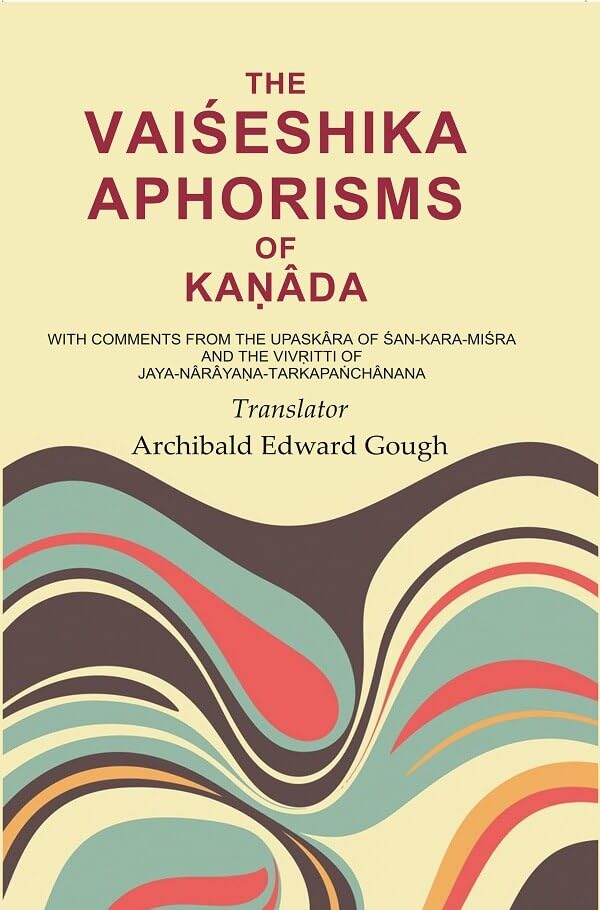
Description
The Vaiśeshika Aphorisms represent one of India’s six foundational philosophical schools, offering a profound system of metaphysics and ontology that shaped Hindu thought for millennia. This edition presents Kaṇâda’s original text alongside the Upaskâra commentary by Śaṅkara Miśra and the Vivṛitti of Jaya Nârâyaṇa—making it an essential resource for scholars and serious students of Indian philosophy. Whether you’re studying comparative metaphysics, classical Indian schools of thought, or preparing for philosophy examinations, this 320-page volume provides the authoritative framework for understanding Vaiśeshika’s unique categories of being, causation, and the nature of reality. Published by Gyan Publishing House, it combines scholarly rigor with accessibility.
- Print length: 320 pages
- Language: English
- Publisher: Gyan Publishing House
- Publication date: 1 January 2024
- Reading age: 15 years and up
- Dimensions: 11 x 2 x 3 cm
- ISBN-10: 9362805367
- ISBN-13: 978-9362805362
Frequently Asked Questions
What is the Vaiśeshika Aphorisms of Kaṇâda?
The Vaiśeshika Aphorisms (Vaiśeshika Sutras) is one of the six orthodox schools of Indian philosophy, attributed to the sage Kaṇâda. It presents a systematic ontology and metaphysics, categorizing reality into nine substances, qualities, and actions. This edition includes detailed commentaries that help readers understand the original aphorisms’ philosophical significance and application.
Who should read this book?
This book is ideal for philosophy students, scholars of Hinduism, researchers in classical Indian thought, and anyone seeking a rigorous introduction to metaphysics from an Eastern perspective. It’s particularly useful for those studying for competitive exams in Indian philosophy or preparing academic research on Hindu philosophical schools.
What commentaries are included in this edition?
This edition features two important commentaries: the Upaskâra by Śaṅkara Miśra, which provides essential clarifications and interpretations of Kaṇâda’s aphorisms, and the Vivṛitti by Jaya Nârâyaṇa, offering further elaborations. Together, they make the complex original text more accessible to modern readers.
Is this book suitable for beginners in Indian philosophy?
While this book requires some familiarity with Sanskrit philosophical terminology, the included commentaries make it more accessible than the aphorisms alone. Readers new to Indian philosophy may benefit from starting with introductory texts on Vaiśeshika school before diving into the aphorisms themselves.
How does Vaiśeshika differ from other Indian philosophical schools?
Vaiśeshika is unique for its systematic approach to metaphysics and categorization of reality. Unlike schools emphasizing non-duality, Vaiśeshika recognizes the reality of both individual substances and their qualities. It also emphasizes atomism and logical reasoning as paths to knowledge, distinguishing it from other Hindu philosophical traditions.